
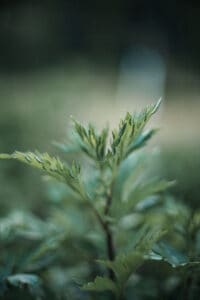
Mugwort is the plant for dreamers. Its scientific name is Artemisia vulgaris, named after Artemis, Greek goddess of the Moon and the hunt. As the name suggests, this herb ushers you into the lucid world and wakes up the parts of your subconscious mind that have been left to settle and collect dust. In this way, it helps you process wounds past so you can experience greater closure and healing in your life.
This herb is one of the first plants I ever worked with when I began my plant path nearly two decades ago. There is something about those first plants that stick with you and become a touchpoint throughout your herbal journey. For me, Mugwort is just that, and in today’s plant profile you will learn all about this treasured remedy and how it is used in traditions around the world.
Common name: Mugwort
Latin name: Artemesia vulgaris
Family: Asteraceae
Tastes: Bitter, Pungent, Aromatic
Affinities: Digestive, Liver, Gallbladder, Nervous, Female reproductive
Actions: Bitter Tonic, Carminative, Cholagogue/Choleretic, Nervine Sedative, Nervine Stimulant, Emmenagogue, Mild Uterine Antispasmodic, Mild Anthelmintic
Energetics: Warming, Drying, Relaxant, Stimulant

Mugwort’s Taste
Mugwort tastes bitter, pungent, and aromatic. This combination of flavors lends it a particularly unique array of actions. While most bitters have a cooling effect on the body, Mugwort’s pungent taste warms it up and categorizes it as an aromatic bitter. The bitter and aromatic qualities impact digestion, albeit in different ways.
Its pungent taste stimulates circulation and blood flow in the digestive system, thereby warming the region. Combined with Mugwort’s carminative and antispasmodic actions, it reduces tension in the entire digestive system. The bitter taste stimulates the production and secretion of bile through the liver and gallbladder, which acts as a natural laxative and aids your body in digesting and assimilating fats and oils. Mugwort’s cooling bitter and warming carminative actions make this plant a formula unto itself, meaning it’s like combining a bitter herb with a carminative herb.
Mugwort’s Affinities
As you can see with its carminative and bitter tonic properties, Mugwort has an affinity for the digestive system. Likewise, with its choleretic and cholagogue actions, it supports the liver and gallbladder, albeit a little more mildly than really strong bitters like Gentian (Gentiana lutea).
Mugwort has an affinity for the nervous system and is a superb remedy for nervous digestion since it acts on the highway between the nervous and digestive systems. Lastly, Mugwort is a traditional remedy for female reproductive health. It is used for every season of life, from puberty to menopause.

Mugwort’s Actions
|
Mugwort is a medicinally rich plant with many actions that tie back to its affinities and tastes. For example, as a bitter tonic, cholagogue, and choleretic, it increases bile production in the liver and gallbladder. It is also a mild anthelmintic and can help eliminate parasites. However, it is not nearly as strong in this aspect as Wormwood (Artemisia absinthium) and Sweet Annie (Artemisia annua). It aids in clearing stagnation in the liver and, to a lesser extent, in the gallbladder. All of this makes digestive support a key benefit of Mugwort.
As a nervine stimulant, Mugwort revitalizes the nervous system. Although the word “stimulant” might conjure images of coffee and other caffeine-containing plants, Mugwort does not energize the nerves in that way. Rather, it stimulates nerve activity when it lacks responsiveness because of insufficient blood supply, poor nutrition, or trauma. Although it may seem contradictory, Mugwort is also a nervine sedative and soothes nervousness, anxiety, and tension. This makes it highly indicated for deficient or degenerative nerve conditions, as well as excessive nervous system activity such as nervousness, anxiety, and insomnia.
This plant is well known for its profound effect on the subconscious mind. Although you can take it to help you fall asleep, it can also induce vivid, sometimes lucid, dreams. It can stimulate dreaming so much that it can leave you tired when you wake up, so experiment with this plant to see if it’s the right herb to support your sleep. For some, it’s incredibly helpful for sleep, while others feel like they were busy all night dreaming.
Mugwort is an emmenagogue and stimulates menses in two distinct ways. First, it stimulates blood flow to the reproductive organs, relaxes a tense uterus, and encourages healthy blood flow with its pungent and aromatic compounds. Second, it has a draining and downward-bearing action that encourages menses through its bitter tonic properties. This makes it a highly useful remedy for both amenorrhea and dysmenorrhea.
Not often talked about, a stagnant liver is often the culprit behind PMS symptoms because it is responsible for breaking down and metabolizing complex reproductive hormones. When it cannot do this efficiently, there are often hormonal side effects which can impact mood, as well as stagnating the liver in general. Through Mugwort’s bitter and aromatic qualities, it disperses and supports a stagnant liver. Combined with the plant’s nervine sedative actions, it is a complete formula for PMS complaints in a single plant.
Lastly, Mugwort is indicated for hyperandrogenism, which occurs when there is an excess of androgen hormones and heightened levels of testosterone in comparison to estrogen and progesterone. It affects the higher regulatory parts of the brain that direct hormonal production and, in turn, it can impact the liver’s metabolism of said hormones.

Mugwort’s Energetics
Mugwort is a complex plant energetically because it is both bitter and aromatic. While bitter plants are typically cooling, aromatics are warming. Although Mugwort is a bitter tonic, I think of its aromatic properties as more dominant, and therefore consider it to have a net warming effect. You can back this up further with its ability to warm the uterus and digestive system, stimulate circulation, and push stagnation up and out.
Finally, it’s worth noting that the bitterness and aromatic nature will differ from region to region. Some Mugwort plants are more aromatic or bitter, and this influences its warming or cooling effects. Because Mugwort is warming and drains stagnation, I see it as a drying plant. Lastly, Mugwort is a relaxant. You can see this with its antispasmodic, nervine, and carminative actions.
According to Ayurveda, Mugwort increases and aggravates pitta while decreasing and balancing vāta and kapha. It raises pitta because of its warming and stimulating properties and lowers excess vātta and kapha for these same reasons. In kapha, it increases circulation and drains stagnation. In vāta, it relaxes excess tension in the body and mind and warms up their cold nature. However, it can lead to excess dryness over time, so keep an eye out for this. As with many herbs, Mugwort may need to be formulated with other plants to prevent aggravating the dryness of vāta.
Mugwort is primarily used for the cold/depression, damp/stagnation, and wind/tension tissue states. Mugwort balances coldness through its warming properties, stagnation with its drying energetics, and tension through its relaxant and antispasmodic actions.
Psychological and Emotional Aspects of Mugwort
Mugwort is a specific remedy for sensitive, dreamy people who struggle to be present. They often have one foot in both worlds, perhaps leaning more toward imagination than reality. These people may have heightened sensitivity not just emotionally, but to sunlight, noise, and scent. It is as if their sensory gating channels are too open, leading them to experience everything more intensely. They can also be sensitive to the energies of people and spaces around them, leaving them susceptible to these influences. They may feel anxious and nervous, and have difficulty sleeping.
Mugwort is a traditional remedy for women, especially on the complex pathways that bridge the physical, emotional, and spiritual aspects of sexual trauma. Just as it pulls out and heals stagnated and stuck patterns from the mind, it cleanses and clears trauma from the entire pelvic and reproductive region. Preparing a womb-cleansing bath with Mugwort can be healing and provide a sense of spiritual protection, especially when combined with herbs like Lady’s Mantle (Alchemilla vulgaris), Rose (Rosa spp.), and Calendula (Calendula officinalis).

Mugwort’s Alchemical Correspondences
“What is Venus, but the Artemisia that grows in your garden?” – Paracelsus
I’ve long thought of Mugwort as a lunar plant because of its influence on dreaming, sleep, and the subconscious. However, after considering its medicinal and energetic qualities, I think Mugwort is more accurately ruled by Venus, which is indeed in agreement with Culpeper as well as Paracelsus.
Known as “the great relaxant,” plants ruled by Venus are relaxant, antispasmodic, calm the nervous system, and have an affinity for the female reproductive system. Venus-ruled plants are often emmenagogues, and in this case even more so through Mugwort’s influence on the higher regulatory systems in the brain and the resulting hormonal cascades.
Mugwort is ruled by the Air Element, which you can see through its effects on the nervous system and its ability to relax wind, tension, and spasm. This herb mobilizes stuck energy, similar to how the wind moves and disperses things. Lastly, you can see the Air Element correspondence in the way Mugwort grows. It starts low and bushy on the ground and then reaches up and out, dispersing its volatile oil compounds in the air as it grows.
Mugwort has a very cardinal quality, otherwise known as the Sulfur Principle in alchemy. It is very rich in volatile oils, which you can easily distill. In the alchemical tradition, Sulfur rules the essential oils in a plant. It is this quality that grants Mugwort its warming and pitta-like qualities, driving blood flow, circulation, and providing a stimulant quality to the nerves.
Growing Mugwort
Mugwort is a widespread herb native to North America, Europe, and Asia. Although Artemisia vulgaris is the variety most often used in Western materia medica, you can use the coastal variety and others interchangeably. Mugwort’s ability to thrive in a variety of ecosystems speaks to its resilience and versatility. While Artemisia vulgaris is the common garden variety, you might consider cultivating your local Mugwort species if you have one in your bioregion.
It is best to plant Mugwort in the early spring after a period of cold stratification. The time to harvest it is right before it enters the flowering stage, since that is when the energy will be strongest in the leaves. Although all aerial parts of Mugwort are medicinal, the leaves are used for medicine most often. Mugwort is easy to plant and grows robustly, so find your local variety and get planting.

Mugwort Preparation
Many people do not enjoy the taste of Mugwort as a tea because of its bitterness. That said, this plant is best prepared with alcohol anyway, since water does not effectively extract its volatile oils, which underlie many of its medicinal properties. It is best to use fresh Mugwort leaves when preparing a tincture and to use a higher alcohol percentage to produce a potent Mugwort medicine. I have prepared Mugwort spagyrics fresh in roughly 65% alcohol at a 1:2 ratio.
Mugwort has a long-standing traditional use in Chinese medicine for moxibustion. In this practice, the leaves are harvested, dried, ground, sifted, and burned like incense over a specific acupuncture point to raise the qi and restore energy and vitality to that area. Mugwort moxibustion is often used over the reproductive organs to stimulate the system, remove stagnation, and encourage healthy menses.
Another way to use this herb medicinally is to hang the dried leaves in a steam room or shower. As the steam rises, you inhale the volatile oils. Alternatively, you can add them to a ritual or sitz bath to stimulate menstruation. Robin Rose Bennett uses Mugwort with Ginger (Zingiber officinale) to make a topical oil that you can apply to the pelvic area to increase warmth and circulation, alleviate menstrual cramps, relax muscles, and disperse stagnation.
Lastly, Mugwort has long been used to encourage lucid dreaming and to help you connect with the dreaming realm. To work with it in this way, you can prepare a Mugwort sachet and place it beneath your pillow or burn the dried plants in your bedroom to stimulate dreaming. I recommend you proceed with caution here, since those dreams can sometimes be so wild that you wake up tired in the morning.
Mugwort is for the dreamers or for those who wish they were! If you tend to experience excess fantasy in your day-to-day, Mugwort can help you feel more grounded in your body. Alternatively, if the dreaming realm is one you want to connect with, Mugwort can help you explore it.
Mugwort connects you with your subconscious and higher mind. It sweeps away the dust, illuminates the old and forgotten spots in your mind, and gives you a chance to heal those wounds further. Whether you smoke, drink, or bathe in it, this plant is ready to provide its medicine and be a part of your inner healing journey.
Digestive Nervine Triplet
33% Mugwort (Artemisia vulgaris)
33% Chamomile (Matricaria recutita)
33% Catnip (Nepeta cataria)
This deceptively simple triplet formula packs a punch. Each of these herbs is nervine sedative and calms the mind, thereby soothing nervous digestion. Mugwort and Chamomile are bitter tonics and increase digestive secretions. Carminatives Catnip and Chamomile relax tension and spasms in the GI. Combined, you have a potent formula that combines nervine sedative, aromatic carminative, and bitter tonic actions in one. This formula can be taken in tincture form as needed.
Frequently Asked Questions About Mugwort
What are the main benefits of Mugwort?
Mugwort supports the nervous, digestive, liver, gallbladder, and female reproductive systems while helping relieve stagnation, tension, and nervous digestion.
Why is Mugwort considered one of the best Herbs for Dreams?
Mugwort is known for promoting vivid, lucid dreams and deepening awareness of the subconscious mind.
How does Mugwort support digestion?
Its bitter and aromatic qualities stimulate digestive secretions, increase bile flow, relax digestive tension, reduce gas, and improve fat digestion.
Who benefits most from Mugwort?
Mugwort is especially helpful for highly sensitive people who experience nervous tension, anxious digestion, vivid inner lives, or difficulty feeling grounded.
Does Mugwort help the nervous system?
Yes, it can. Mugwort is both a nervine stimulant and nervine sedative, helping revitalize depleted nerves while calming excess nervous tension and anxiety.
Can Mugwort support menstrual health?
Yes. Traditionally, Mugwort has been used to encourage healthy menstrual flow, relieve menstrual cramps, reduce pelvic stagnation, and support PMS associated with liver congestion.
What are Mugwort’s energetics?
Mugwort is warming, drying, relaxing, and mildly stimulating, making it especially useful for cold, damp, stagnant, and tense tissue states.
What is the best way to prepare Mugwort?
Fresh-leaf tinctures are best overall, because alcohol extracts Mugwort’s volatile oils more effectively than water. It is also traditionally used in baths, moxibustion, topical oils, and dream sachets.
Can Mugwort be used for lucid dreaming?
Yes. Among the traditional Herbs for Dreams, Mugwort is especially valued for encouraging vivid, sometimes lucid, dreams. Individual responses vary, and some people may find the dreams intense enough to disrupt restful sleep.
Who should not take Mugwort?
People who are pregnant should avoid taking Mugwort internally because it has traditional emmenagogue properties that stimulate the uterus. Those with allergies to plants in the Asteraceae family (such as Ragweed, Chamomile, or Yarrow) may also be sensitive to Mugwort.
What does Mugwort taste like?
Mugwort has a bitter, aromatic flavor with earthy, resinous, and slightly spicy notes. Its bitterness supports healthy digestion and liver function, while its fragrant volatile oils contribute to its warming, carminative qualities.
Is Mugwort safe during pregnancy?
No. Mugwort is generally not recommended during pregnancy because of its traditional use as an emmenagogue, meaning it can stimulate uterine activity. While it has many valuable medicinal properties, it should be avoided internally throughout pregnancy unless specifically recommended by a qualified healthcare practitioner.
Materia Medica Monthly
Access the full 20+ page monograph for Mugwort and 75+ other herbs when you join our Materia Medica Monthly community today!