
Comfrey At a Glance
Common name: Comfrey
Latin name: Symphytum officinale
Family: Boraginaceae
Part Used: Leaf, root (roots are slightly more demulcent and moistening than leaves)
Tastes: Mineral salty, sweet, astringent
Affinities: Digestive system, mucosal membranes, musculoskeletal system
Actions: Demulcent, vulnerary, astringent
Energetics: Cooling, moistening (& drying), tonifying
Geographical Distribution: Comfrey is a traditional European plant that thrives with minimal effort. It is very easy to propagate from even the slightest bit of root, and it can take over your garden or land, so use caution when mowing or tilling if you don’t want it to spread.

Comfrey’s Tastes
Comfrey has an interesting combination of tastes: salty, sweet, and astringent. Its salty taste is more of a mineral salt taste than a sea salt taste. It is the salty taste of terrestrial plants, which is unlike the true salt taste from aqueous plants, such as seaweeds. Comfrey’s taproots go very deep into the soil and may access latent mineral beds, bringing them to the surface. Orchardists often like to have Comfrey around their trees because it can bring up minerals from deeper soil.
Comfrey has a sweet taste, but it’s not sweet like sugar. Comfrey’s mucilaginous, slimy texture, demulcent quality, and sweet taste help moisten the mucosa of the gut, lungs, and urinary tract, and even the female reproductive tract.
We see similar demulcent properties in other plants; for example, Corn silk (Zea mays) is a demulcent for the urinary tract, while Licorice (Glycyrrhiza glabra) is an excellent demulcent for the respiratory tract. Marshmallow (Althaea officinalis) is a great demulcent for the digestive system, and so is Comfrey. Comfrey is also mildly astringent, so while it is soothing to the GI tract, it will also help tone the tissues and help stop bleeding.
Comfrey’s Affinities & Actions
Soothing and Tonifying to the GI
Comfrey’s salty, sweet, and astringent tastes translate into its primary actions in the body within the mucous membranes of the digestive tract, a primary affinity. The sweet taste and demulcent action soothe the gut lining and cool heat and inflammation. This is interesting, juxtaposed with the fact that Comfrey is also a little astringent and mineral-salty in taste, as it tightens and tonifies the digestive tract lining, as we saw in the section on tastes.
Vulnerary for the Skin and Internal Mucosa of the GI
A vulnerary is a substance (usually topical) that promotes wound healing. When you get a cut or scrape, applying Comfrey topically can help the wound heal by modulating inflammation and exerting astringent and antimicrobial effects. Many properties of Comfrey contribute to a net vulnerary effect, which is present wherever the herb comes into direct contact with tissues — including the skin and the internal surfaces of the body, such as the gut lining.
Comfrey has traditionally been used internally for various types of ulceration, including gastric ulcers. It would probably also help leaky gut syndrome, though I haven’t seen any data on the topic. That said, there are contraindications for the internal use of Comfrey, which we’ll get into shortly.
Comfrey is excellent on the skin for cuts, scrapes, abrasions, and lacerations, as long as they’re not deep. It is also fantastic for bleeding wounds — it contains a constituent called allantoin, which is also present in Plantain (Plantago spp.), another fantastic vulnerary herb. The vulnerary effect of these plants is often attributed to the allantoin, though you really can’t reduce an herb’s effect to a single constituent. It isn’t only the allantoin that heals the skin; it’s the whole plant. The serious caution with topical use of Comfrey is to use it mainly for superficial wounds, not deeper ones. It does such an excellent job that it can actually heal a deep wound too quickly. This plant heals from the skin’s surface inward, so it can seal the wound even when the underlying tissue has not fully healed, trapping bacteria and possibly leading to infection. For very deep wounds, especially puncture wounds, make sure the wound can be properly cleaned and drained. With deep wounds, infection can be serious, especially with puncture wounds. If you see a red streak going up your arm, you need to drink a bottle of Echinacea and go straight to the hospital, because that can be really serious and lead to sepsis.
As a father of two boys, we go through a lot of Comfrey oil and vulnerary salve in our household, because there’s a constant flow of knee scrapes, bike falls, etc. Parents know exactly what I’m talking about!
Moistening Expectorant for the Lungs
Comfrey affects the lungs, so it can be used as a moistening expectorant for dry, irritable coughs. However, because other great remedies can also serve this purpose, Comfrey would not be my top choice for this use case.
Building and Healing for Connective Tissue and Bone
Comfrey has a distinct action on the musculoskeletal system, especially the bones, and can be used topically for musculoskeletal injuries, including strains, sprains, and broken bones. I have used Comfrey to help people with torn ACLs, broken ankles, broken arms, and cracked ribs. This plant is inflammation-modulating, healing, and nutritive, and it supports ligaments, tendons, bones, as well as skin.
Matthew Wood says that if you’re using Comfrey to heal bones, it’s important to make sure the bones are properly set first. Matthew talks about a couple of cases where bones weren’t put back into proper alignment before using Comfrey, and they seemed to heal in the incorrect placement, leading to chronic issues. It is a bit of a mystery how that works. Topical use of Comfrey doesn’t provide many minerals, so something chemical is going on that may increase osteoblasts, or something similar. We don’t understand how it works, but it works very well.
The easiest and most popular way to apply Comfrey topically is to infuse the leaves in oil (see the recipe below). Comfrey also makes an excellent poultice (see the recipe below), and I’m a fan of using it this way. The fresh leaf is best for this, but you can use the dried, powdered leaf to make a paste that can be applied as a poultice.
To make a fresh poultice, grind the herb as finely as possible, and then blend it with a little oil. Castor oil is thick, but it’s an excellent choice because it can carry the herbs’ medicinal properties deeper into the tissues, which is ideal for addressing a musculoskeletal injury. I like to add a little Cayenne pepper (Capsicum annuum) — just enough to warm the skin. The combination of Cayenne and Comfrey works because Cayenne provides localized circulatory stimulation that increases blood flow to the area and dilates blood vessels, which helps the Comfrey penetrate more deeply. Cayenne also helps relieve pain because it contains capsaicin, which, along with other compounds, acts on substance P, a molecule associated with the pain response. Substance P is a neuropeptide that causes the contraction of smooth muscle and dilation of blood vessels. It acts as a potent neurotransmitter, especially in the transmission of signals from pain receptors. If you use Cayenne frequently enough, it will drain the local area of substance P and support pain relief. When someone has a connective tissue or skeletal injury, it can hurt a lot, so a topical Comfrey poultice with Cayenne is a fantastic way to relieve pain and significantly shorten recovery time for musculoskeletal injuries.
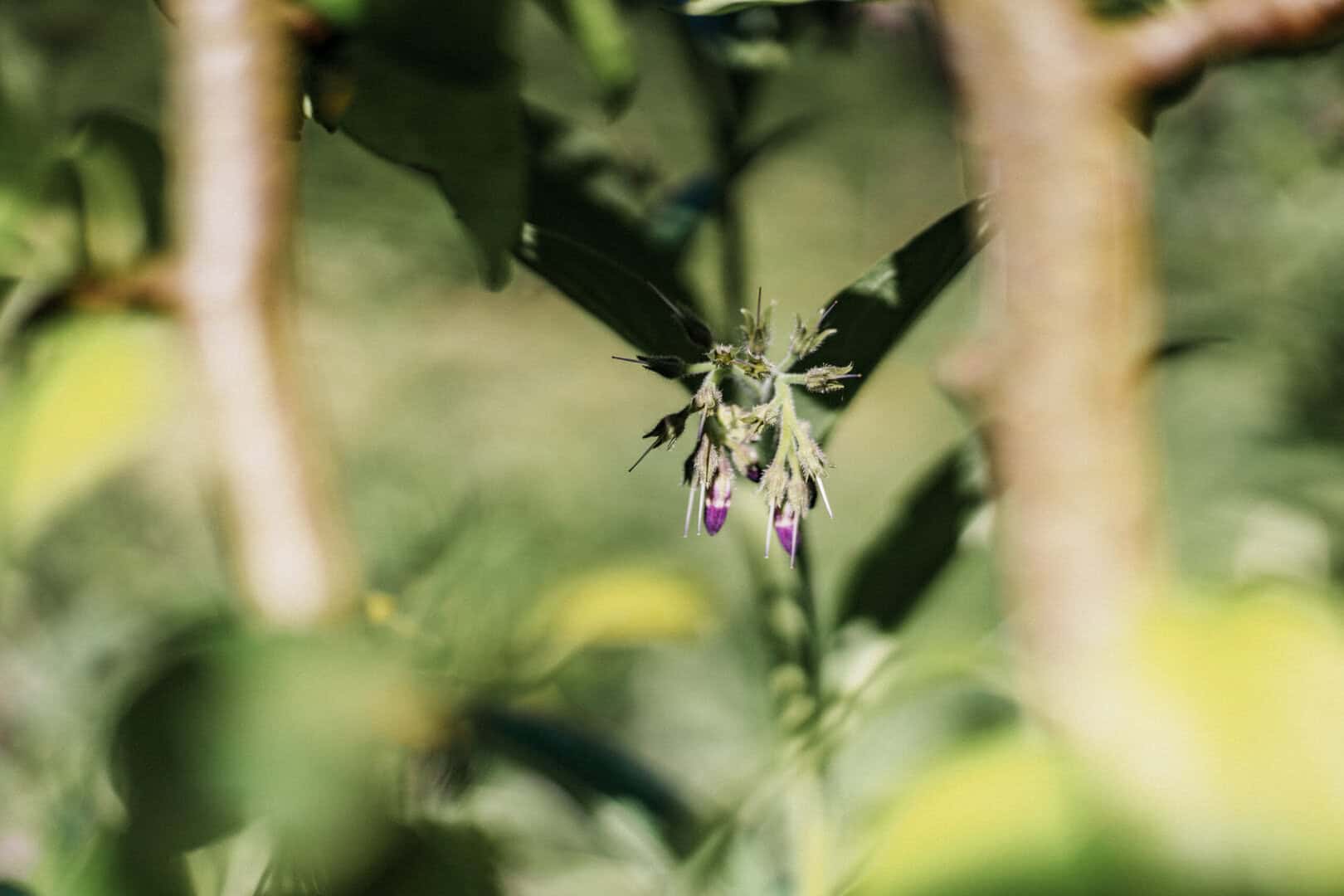
Comfrey’s Energetics
Comfrey is cooling and demulcent, which lends it a moistening property. It is also astringent, which is paradoxical because we usually think of astringents as being drying and demulcents as being moistening. So what is the moisture property of Comfrey — is it moistening or is it drying? The answer is, in a way, both.
Our main energetics are grounded in a fourfold model of temperature (cooling or heating) and moisture (moistening or drying), rooted in the four elements. In the Physiomedicalist tradition of North America, there were three primary energetics: stimulant, relaxant, and tonic. Breaking down the word “tonic” and its meaning is a long discussion, and we have a post all about tonics. Oftentimes, people think of a tonic as something that is nutritive and strengthens your system, which Comfrey certainly does, but the other meaning of tonic refers to tissue tone. Comfrey increases tone through its astringency, which is what makes it an amazing herb for the GI tract. If someone has a gastric ulcer, you need to cool the heat, inflammation, burning pain, and irritation, and also astringe the gut lining to calm the bleeding. If someone has an ulcer, they should probably see a doctor to make sure they’re not bleeding too heavily, and you should also astringe the tissue — Comfrey is fantastic for that purpose.
Understanding Comfrey’s Traditional Use & Safety
Comfrey has long been used topically in all the ways we’ve discussed, and it was traditionally used internally in specific circumstances, such as to heal ulceration in the gut lining. Currently, people are fearful of using Comfrey internally because it is widely known to be toxic. The best way to alleviate fear is to understand exactly what Comfrey is indicated for, and who should not use Comfrey.
Pyrrolizidine Alkaloids and Toxicity
There are many categories and types of pyrrolizidine alkaloids based on their chemical structure, including saturated and unsaturated PAs and pentacyclic PAs. Each type of PA has varying degrees of toxicity. The PAs in Comfrey are moderately toxic compounds, and constituent analysis of Comfrey has shown that the leaves have fewer PAs than the roots, and that older leaves have the lowest PAs (as mentioned above). If you use Comfrey internally, it’s best to use mature leaves to make sure you’re ingesting the lowest amount of PAs possible.
Pyrrolizidine alkaloids aren’t themselves toxic, but their metabolites are. When the liver metabolizes PAs, they can become toxic to the liver, and they can produce HSOS, Hepatic Sinusoidal Obstructive Syndrome. The sinuses of the liver can become stagnant, congested, and blocked, which can lead to liver toxicity and failure. A strong, healthy person without liver problems could probably tolerate a small amount of Comfrey internally for a short period. However, if the liver is already compromised, tolerance will be lower.
Who Should Not Take Comfrey Internally
Never give Comfrey to a pregnant or breastfeeding woman, and never give it to children internally.
People who have liver impairment or liver disease should not use Comfrey internally. This includes people with hepatitis and cirrhosis. It also includes people who may not have diagnosable liver disease, but drink a lot of alcohol or use drugs.
Topical use of Comfrey is safe for anyone because significant absorption of pyrrolizidine alkaloids through the skin is unlikely. Additionally, topical use is typically for treating broken bones or healing superficial wounds, so the treatment timeframe is naturally limited.

Comfrey’s Energetic Architecture
Comfrey is a great example of a Saturnian herb. Saturn is the planet that governs the bones, connective tissue, and all structural aspects of the body. Comfrey is also associated with Capricorn, which is ruled by Saturn, and which rules the joints. Saturn’s glyph looks like an ‘h’. It’s the cross over the crescent, which shows the containment of the spirit in matter.
Saturn has a downward-bearing quality, and it governs this physical reality. It also relates to the structural and physical limits and boundaries of life and of the body. We see this with Comfrey as well; it strengthens the body’s structural integrity through the bones, connective tissue, gut lining, and skin. Comfrey literally repairs the skin and builds up the body’s physical structures.
We also see Saturn’s influence in Comfrey’s appearance. It grows quite tall, and then it falls. It is earthbound, terrestrial, and fixed. It grows up, and then it falls back to Earth, and this is another attribute of Saturn. Saturn is astringent in nature and has the mineral saltiness we discussed. The mineral salt taste indicates minerals which build up and strengthen the physical structures.
Comfrey’s main element is Water, which makes sense given its demulcent properties, moistening nature, and ability to soothe, cool, nourish, and hydrate tissues. The Water element governs the body’s mucosal membranes and fluid element, both of which are influenced by Comfrey.
In terms of the three Alchemical philosophical principles, I place Comfrey under the Salt principle, which is made up of the Earth and Water elements. This is for the same reason it is associated with Saturn. When you think of fixed Water and Salt together, they form the sign of Scorpio. Scorpio is often associated with toxicity and poisons, and that is the more detrimental side of Comfrey — it can be toxic.
In terms of Comfrey’s zodiacal sign, Scorpio makes sense based on its principles — Water element, fixed mode, and Salt principle using alchemical terminology. That said, it is also a very Capricorn-type herb, with its earthiness and its connection to bones and the body’s structure.
Comfrey Recipes
Comfrey Cayenne Poultice for Sprains, Strains & Connective Tissue Injuries
Ingredients:
- Fresh Comfrey leaves
- Pinch of Cayenne powder
- Small amount of Castor oil – sufficient to make a thick paste
Instructions:
- Finely chop or grind the fresh Comfrey leaves into a paste.
- Blend in enough Castor oil to create a thick, spreadable consistency.
- Add a small pinch of Cayenne powder and mix well. Test a small amount on your skin (it should create a gentle warming sensation but should not burn).
- Apply the poultice directly over the affected area.
- Leave in place as desired, replacing with a fresh poultice as needed.
*Note: Do not apply to open wounds. If you leave the Cayenne out, you can use it on superficial wounds, just not on puncture wounds or wounds that require drainage.
This poultice is best for sprains, strains, bruises, strained or torn ligaments, and broken bones (AFTER the bone has been properly set). Comfrey supports the healing of connective tissue and bones, while castor oil helps carry the preparation deeper into the tissues. If you use Cayenne in the poultice, it will increase local circulation and help relieve pain.
Simple Comfrey Oil
Ingredients:
- Dried Comfrey leaves
- Carrier oil of your choice
Instructions:
- Infuse Comfrey leaves into a carrier oil using your preferred herbal oil infusion method.
- Strain the herbs from the oil.
- Apply the infused oil directly to the affected area or make it into a salve.
*Note: Because Comfrey promotes rapid surface healing, avoid using it on deep wounds or puncture wounds until they have been properly cleaned and can drain.

FAQ About Comfrey
Is Comfrey safe to take internally?
It depends greatly, and abundant caution is necessary. Because Comfrey contains pyrrolizidine alkaloids (PAs), internal use is generally discouraged in modern herbalism, and should only be considered within its traditional context and appropriate safety guidelines.
Why is Comfrey so good for wound healing?
Comfrey is a vulnerary herb that helps support tissue repair, reduce inflammation, and promote healing.
Can Comfrey be used on broken bones?
Yes, however, it’s necessary to ensure the bones are set in optimal alignment first. Traditionally, Comfrey has been used topically to support healing of broken bones, sprains, strains, and connective tissue injuries after the injury has been properly treated.
Should Comfrey be used on deep wounds?
No. Comfrey may seal the surface before deeper tissues have healed, increasing the risk of trapping bacteria.
Who should never take Comfrey internally?
Pregnant or breastfeeding women, children, and anyone with liver disease or impaired liver function should avoid internal use of Comfrey.
Which part of Comfrey is safest?
Traditionally, mature leaves contain lower levels of pyrrolizidine alkaloids than young spring leaves or roots.
What are Comfrey’s primary herbal actions?
Comfrey is primarily a demulcent, vulnerary, astringent, nutritive, tonic, and inflammation-modulating herb.
Which body systems does Comfrey support?
Comfrey primarily supports the skin, connective tissue, bones, digestive mucosa, and to a lesser extent, the respiratory tract.