
In the summer, people with hot constitutions (those with a predominance of pitta dosha or choler) may be especially sensitive to the heat. Extra heat can manifest as heat-pattern headaches, among other things. Many underlying patterns can lead to a headache, and temperature is one of the most important. Distinguishing between a hot and a cold headache is very important because if you get it wrong, the remedies you give may not work or they may make the headache much worse.
Another distinguishing factor for headache types is whether the headache is due to excess or deficiency (and these tend to accompany temperature, as blood brings heat and vitality). These terms refer to the nature of the vital force and how it moves within a person. The flow of blood follows the flow of vitality through the system, because blood is the physical substance that delivers vitality throughout the whole system, whether in the form of nutrients, oxygen, or more subtle substances. We can think of blood flow as an indicator of excess or deficiency.
An excess-type headache is when a person has too much blood in the head, which manifests as heat because blood carries heat. An excess-type headache involves excess blood flow and is accompanied by heat signs. On the other hand, people with poor peripheral circulation usually have cold as a primary sign — cold hands and feet, etc. A deficient-type headache, or a deficiency in blood flow, comes with cold signs.
Assessing Headache Types
Signs of Excess Heat
So how do you recognize a hot-pattern headache, and heat signs in general? If you’ve ever been really hot, for example, if you’ve gone hiking in the desert in the summer or something similar that overheated you, this should give you a good idea of what heat signs look and feel like, such as excess sweating, a desire for cold foods and drinks, and an aversion to hot foods and drinks (both in temperature and spice). Heat symptoms are aggravated by hot weather, hot places such as saunas or hot tubs, and overheating during exercise. If a headache comes on after being out in the heat, for example, after working in the garden or hiking in the sun, you can assume it’s a heat-type headache pattern.
Too much heat is too much vitality moving through your system, which can manifest in the mind, making you irritable and agitated, with fiery emotions such as anger. Insomnia can also arise from this state.
When there’s too much heat in the system, the pulse may be rapid and superficial. The body of the tongue may be red, especially at the tip. In Chinese medicine, the tip of the tongue corresponds to the heart, which in turn relates to psychological state. So a red-tipped tongue often indicates heat, agitation, and mental stress. If there’s a yellowish coating on the tongue, it indicates heat. Red flushed skin on the face is another classic sign, and the sclera of the eyes may be red or bloodshot.
Qualities of Pain
It is essential to be clear about the quality of the pain, so when you’re assessing headaches in others, you should ask them to describe how the pain feels. To facilitate this, you can ask differential questions to help clarify the situation. Sometimes it’s difficult to describe pain, so with heat-induced pain, keywords to look for include sharp (as opposed to dull) and explosive. This is why I call it exploding head syndrome, because the pain radiates outward. Visually, you might see your client holding their head, which is a vital response to help contain it.
If we think of the qualities of heat more esoterically, in Chinese medicine we have the concept of yang, which is an upward and outward radiating aspect of the vital force. More specifically, it can be an explosive, sharp pain that radiates outward. The skin may feel hot, and the pain is aggravated by heat — both environmental heat and hot or spicy foods. There may be irritability, anger, and frustration.
When you have a headache and, for example, eating hot, spicy Mexican food makes it worse, that is a key indicator of a hot headache. This type of headache is usually alleviated by cool water, an ice pack, jumping into a cold river, or taking a cold shower. Conversely, a hot, steamy shower would make the headache worse.
Activity levels also play a role, as they determine how blood moves in the body. Often, if something worsens with activity, that is an indicator of heat. By contrast, when the pain or discomfort gets better with movement and is worse with holding still or lying down, that’s an indication of a cold-type headache.
Headache Location and Tension Level
It is important to understand the location of a headache. Most headaches are localized to a specific area, such as an occipital headache at the back of the head, a temporal headache on the sides, a frontal or sinus headache at the front of the head or face, or a vertex headache at the top of the head. Some herbs are specific to particular areas of pain.
Another factor to assess is whether the headache pain is accompanied by tension or constriction, which is traditionally referred to as wind. In modern terms, we think of that as a tension headache. There may be muscular tension in the neck and shoulders, or tension in the blood vessels due to constriction. If the blood is pushing up into the head and the blood vessels are constricted, that’s a very painful combination, because there is more blood coupled with less vascular space, which leads to a sensation of pounding and exploding outward. The blood is trying to move, and everything is filled to the brim, so to speak. Differentiating that tension can be very important, as it will significantly influence your therapeutic strategy. What do we want to do with tension? We want to relax it.
These distinctions are crucial. If you misunderstand the factors and recommend the wrong remedy, it either won’t do anything or, in the worst case, will make the headache much worse.

Headache Triggers
When you’re working with someone who gets headaches, especially chronically, it’s important to understand the triggers. Headaches can arise from a wide variety of causes: neurological, inflammatory, digestive, food intolerances, or liver issues. It can also be humoral (constitutional), seasonal, or weather-related. It could be simple dehydration or even nutrient deficiencies. Understanding what’s going on in a person’s life when the headache occurs, and in the period leading up to it, helps to get to the bottom of the trigger. What were they doing? What were they eating? Were they stressed? Did they not sleep well? There are clues to the triggers in these questions. As a holistically minded herbalist, giving a client a headache formula every time they get a headache is not as good as making sure they don’t get headaches anymore. That is the goal of a holistic, vitalist practice.
Archetypal Contributors to Headaches
It can be useful to look at headaches from an astrological perspective. With heat headaches, usually we see an excess of warm planets triggering things in transit. The main planet to consider is Mars, which is the hottest of the planets. The Sun is also a contributing factor, though it’s more warm than truly hot. Next we have Jupiter, which fills things up and can contribute in that way. Jupiter rules the sign of Sagittarius, which governs arterial circulation and blood flow and is a Fire element sign.
The Fire-element signs are also relevant. Aries is especially important to consider because it’s a cardinal Fire sign ruled by Mars, and it governs the head. Aries is always an important place to look for people who get chronic headaches. Leo is also important because it rules the heart and the cardiovascular system. With all of these Fire signs, the vital force tends to radiate upward and outward. That said, Leo is a fixed Fire sign, so the fire of Leo tends to be Fire trapped within the system that doesn’t vent well.
Ayurvedically speaking, a hot headache is a clear excess of pitta dosha, the dosha of Fire (and Water). If there is tension accompanying the heat, then it’s a pitta-vata headache, because vāta dosha translates to tension and constriction. Finally, the choleric pattern is the heat pattern in the Greek humoral system.
Therapeutic Strategies for Hot Headaches
Now let’s look at some therapeutic strategies to address heat patterns associated with headaches. The best herbs to consider are cooling energetically, which makes sense because we’re specifically addressing a hot pattern. However, not just any cooling plant will do!
Many of the herbs best for treating a hot headache are bitter. The bitter taste has a downward-moving energy, so it drains the vital force downward. Bitters are also almost always cooling. Downward-moving, cooling energy, combined with analgesic, spasmolytic, and/or nervine, anxiolytic, and sedative properties to calm the nervous system, is an excellent combination for alleviating heat-pattern headaches.
Mild nervine relaxants, stronger nervine sedatives, and even hypnotics are excellent for addressing a heat-pattern headache. These actions relieve the primary physiological factors that lead to pain while also correcting the energetic or humoral imbalance — heat.
It may go without saying, but it’s very important to avoid warming herbs with a hot headache, such as circulatory-stimulating herbs, especially those that drive blood up into the head. There are a few cooling herbs that also move blood up into the head, and this is where things can get a little confusing. For example, Lavender (Lavandula angustifolia) and Bacopa (Bacopa monnieri) are very useful herbs, but they’re much better for cold-type headaches. If you’re thinking, “Wait, Bacopa and Lavender are cooling, what’s the problem?” Energetically, they are cooling, but they’re also cerebral circulatory stimulants. When you have a cold-deficiency-type headache, herbs like Lavender and Bacopa will be useful because they’ll move blood flow up into the head. However, with a hot headache, I would not suggest using them even though they are cooling.

Jamaican Dogwood (Piscidia piscipula), Photo by 7Song
My Five Favorite Herbs for Treating Hot Headaches
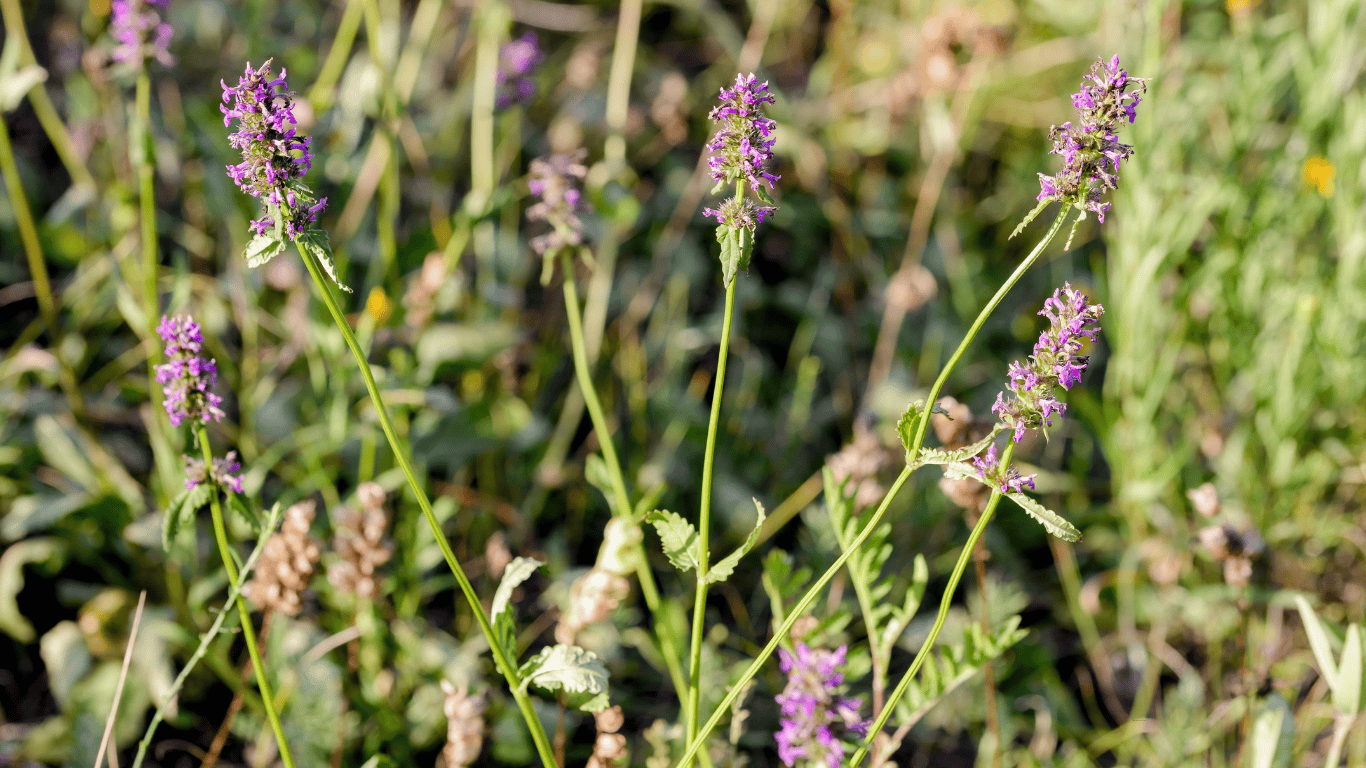
Wood Betony (Stachys officinalis)
Wood Betony is one of my favorite plants of all time. It was one of the first herbs that transformed my life. You’ll find its Latin names listed as Stachys betonica or Betonica officinalis as well — these are all the same herb, European Wood Betony, not to be confused with American Betony, which is in the genus Pedicularis.
Wood Betony is a mildly bitter mint, but it makes a pleasant tea because it’s not too bitter. We usually think of affinities in terms of organs, systems, and tissues, but some herbs have an affinity for a body region, such as the pelvic or pectoral area. Wood Betony has a strong affinity for the head, core, and solar plexus. It has a positive effect on the nervous system, stomach, and digestion, which makes sense since it is in the mint family.
Wood Betony is a gentle nervine, mild spasmolytic, and analgesic specific for head pain. This makes it very useful for calming the nerves and relieving muscle tension. Matthew Wood says Wood Betony is excellent for tension in the neck and shoulders when the vital force moves up too much, gets bound up there, and needs to be brought down. It is also a mild bitter tonic.
Energetically, Wood Betony is cooling, drying, and relaxant, which is exactly what we need for a hot headache. Because of its nervine and spasmolytic properties, it is excellent for tension and stress headaches, especially when paired with heat. I usually give it along with stronger sedatives, hypnotics, and spasmolytics because it is quite mild.
This is probably one of my favorite headache remedies. It is best to catch the headache at the onset and take 3 to 5 mL every 30 to 60 minutes. The dosing strategy with headaches is very important. One reason many people don’t experience relief from headaches is that they aren’t taking enough of the herb, or not frequently enough, to abort the headache. It is much easier to catch a headache early, before its full force comes on, so do try to start taking your herbs as soon as you feel the twinge of a headache.
Wood Betony has a very interesting special potency: it brings the vital force from the head to the gut. It’s excellent for vāta constitutions and mercurial, Gemini, Sagittarius, mutable-type folks whose vital force moves up and out too much and they’re spaced out and ungrounded. Oftentimes, Wood Betony people are very psychologically and emotionally sensitive. They can also be physiologically sensitive, especially to heat and wind.
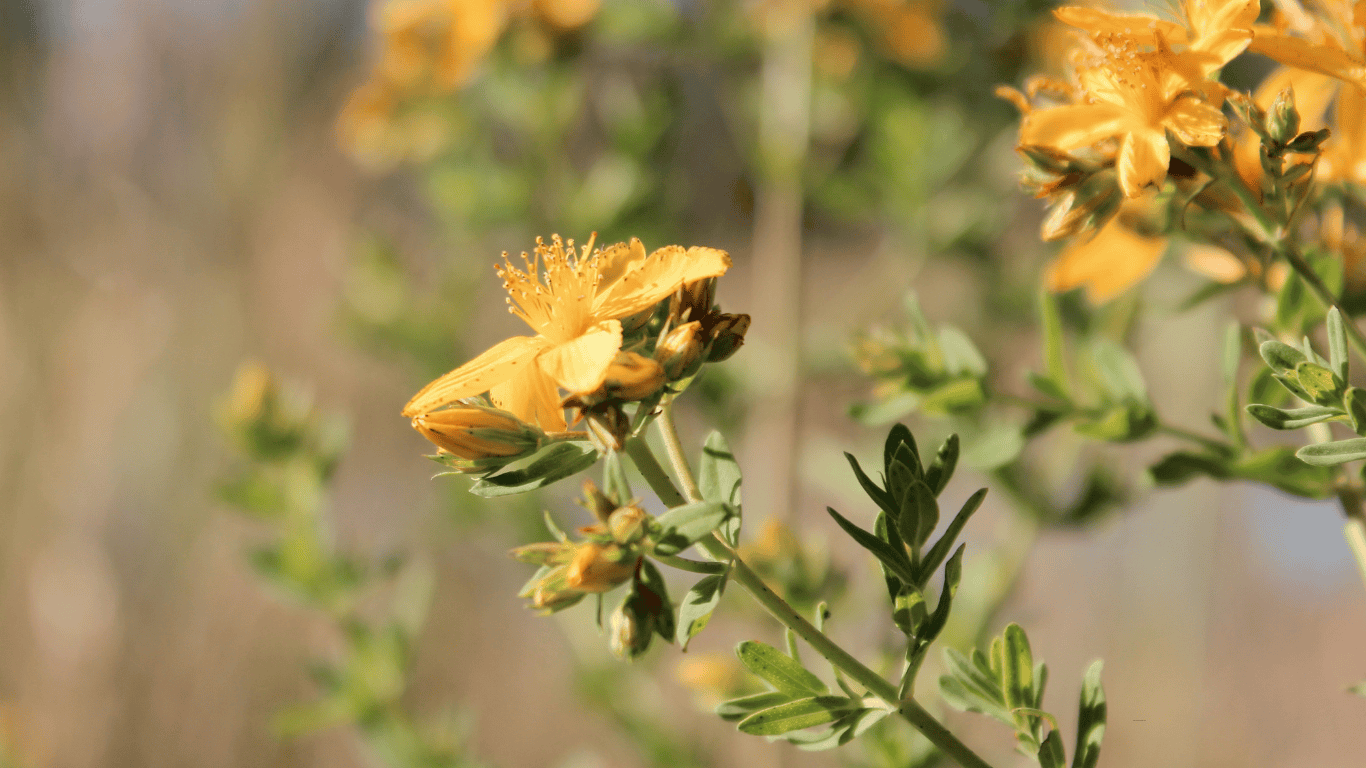
St. John’s Wort (Hypericum perforatum)
Most people think of St. John’s Wort as “the depression herb.” However, St. John’s Wort does so much more. It has a bitter, aromatic taste, the strength of which depends on the environment in which it grows. I’ve had St. John’s Wort that’s very bitter, and I’ve had some that’s more aromatic or almost resinous in its taste.
St. John’s Wort’s primary affinity and main area of action is the nervous system. It also has a potent influence on the liver and the digestive system. As a side note, David Winston teaches that with depression, there are different types. He differentiates between hepatic liver type depression, which is an irritable type of depression where the person is depressed and melancholic, but also agitated and angry. There is also a digestive-based depression. Those differentials are very helpful when you’re working with someone more on the melancholic side. However, St. John’s Wort addresses both.
This herb is our best Western herb for nerve pain, as an analgesic and antinociceptive, which means it helps dull the sensation of pain (a different property than analgesic). St. John’s Wort covers both actions, but is specific for the nerves. It also protects against inflammatory and oxidative damage specific to the nervous system, which is why it’s used for so many degenerative neurological conditions. St. John’s Wort is worth considering for any kind of nervous system issue. It also has some mild spasmolytic properties.
Like Wood Betony, it’s cool, dry, and relaxant. I find the more bitter the St. John’s Wort is, the more cooling it is. Whereas if you get a more aromatic, spicy, or resinous St. John’s Wort, it may be a little less cooling. For headaches, it relaxes the nervous system, cooling any potential neuroinflammation. If the nervous system is overactive, inflamed, or agitated, it innervates the blood vessels, which, when you have overactivity in the nervous system, can constrict blood vessels. That’s where its spasmolytic property comes in. The other thing St. John’s Wort is excellent for is cooling down heat in the liver and digestive system, both of which can contribute to headaches.
Sometimes, when a person eats a food they’re intolerant to, they experience digestive inflammation, and a reflex can occur with food allergy and food intolerance in which the head and gut become engorged with blood. That blood must come from somewhere, so you end up with peripheral vascular constriction, a central vascular opening to get the blood in there, and then you can end up with heat signs in the core and in the head, with contrasting cold signs out in the periphery, such as cold hands and feet.
St. John’s Wort works well with Wood Betony, especially for headaches from trauma injuries. If someone gets knocked in the head and gets a concussion, or has a headache from a blow to the head, St. John’s Wort and Wood Betony are a classic pair. This is a traditional pairing in European medicine, both for physical medical purposes and for esoteric purposes, as these two were often combined for psycho-spiritual protection.
Feverfew (Tanacetum parthenium)
You’ve probably heard of Feverfew for headaches and more specifically, migraines. Like St. John’s Wort, Feverfew is bitter and aromatic. Its main affinities are the digestive and nervous systems. Like our other herbs, its main actions are spasmolytic, bitter tonic, and nervine. Some authors consider it to be anti-inflammatory as well. I think of it as an inflammation modulator, which, to me, is a better descriptor than “anti-inflammatory.” Feverfew is cool, dry, and relaxant in its humoral properties.
Though this is a very popular remedy for preventing migraines, some of the original research on Feverfew may not have been as accurate as we once thought. Febrifuges are generally cooling herbs that clear excess Fire and heat from the TCM Liver. They are specifically used for the Liver Fire rising pattern, which is a Liver pattern in Chinese medicine that begins with Liver qi stagnation, so the vital force is bound up, constricted, tense, and not flowing evenly. Oftentimes there is stress, anxiety, or nervousness, and heat starts to build up. The TCM Liver is not your physical liver. It’s a broader psychophysiological pattern within the system as a whole, rather than in a particular physical organ. It’s a functional system that distributes the vital force throughout the body. When that vital force is not distributed, it gets stuck, heat builds up, and then that heat has to vent. Just like stoking the wood fire in your living room, but keeping all the doors and windows closed, and it gets really hot in there, and then eventually you open the windows to vent that heat out. The heat rises, so you get a red face, red eyes, and an explosion of anger and irritability. It’s a very volatile emotional state, and explosive headaches are often a part of this pattern. Febrifuges are particularly useful for this pattern of headache because they drain heat downward, relax the constriction and tension in the blood vessels, calm the nervous system, and drain heat from the Liver and its channels.
Passionflower (Passiflora incarnata)
Passionflower is a bitter-tasting herb with an affinity for the nervous system, and here we’re shifting with a little bit more of a musculoskeletal system affinity. With Passionflower, we’re delving a little further into more moderate-strength nervous-system remedies rather than a mild nervine relaxant, as we find with St. John’s Wort or Wood Betony. With Passionflower, we’re getting more of a sedative effect, with stronger spasmolytic and analgesic effects. Passionflower is used for excesses of the nervous system that are reflected in the mind. The mind may be racing with too many thoughts, and circular thoughts are a key, specific indication of it, especially when they lead to you not sleeping at night. That is why it’s a great remedy for insomnia — too much thinking, too much anxiety, too much tension, both physical and psychological. Passionflower is excellent if a headache is keeping someone awake at night and they have too many thoughts.
Passionflower has a very complex structure with all of its squiggly stamens. The anatomy of a passion flower is complicated, so I’m not sure what the precise botanical term is for those, whether they would be the pistils or stamens, but to me, Passionflower looks like a scattered, overwhelmed mind.
Like the other remedies we’ve discussed, it is cooling, drying, and relaxant. It calms the nervous system, relaxes constriction, tension, and spasm, and relieves pain. I learned from David Winston that Passionflower is specific for occipital headaches, which start at the base of the skull and gradually creep upward. This is the type of headache I get — it starts in the occipital region that then wraps upward across the forehead like a band, which can be a sign of a tension or a stress headache. Usually, with these headaches, the neck and shoulders are stiff, and there may be other musculoskeletal tension. Passionflower is excellent for this pattern, especially if it’s keeping you up at night.
It is great for hot headaches, especially when coupled with stress, tension, and occipital pain. Learning about using Passionflower was a little piece of gold for me, because I don’t get headaches very often, but when I do, they’re usually occipital. I had a difficult time figuring out how to treat these headaches effectively. I would get the headache calmed down to a manageable place, but I could never get them to go away fully. It wasn’t until I started working with Passionflower, alongside some of the other herbs I use, that I found something that really worked. Tuck that piece of information into your back pocket and use it if you or someone you know gets an occipital headache.
Jamaican Dogwood (Piscidia erythrina)
One of my favorite herbs of all time for any type of pain is Jamaican Dogwood. It is the strongest remedy in our discussion on hot headaches. It is bitter and acrid, and because it’s acrid, it points towards a stronger spasmolytic property. Most acrid herbs have a relaxant, spasmolytic, or in some instances, a mildly narcotic effect, and that’s what we get with Jamaican Dogwood.
Its primary affinities are the nervous system and musculoskeletal system. Its actions are analgesic, spasmolytic, and mildly narcotic if taken in a high enough dose. However, if you think you may be able to get high on Jamaican Dogwood, you’ll be disappointed. It doesn’t work that way, but it will be effective at cutting pain. I personally have used this herb a lot; as someone who’s experienced lower spinal injuries and dealt with a lot of musculoskeletal pain myself, I love Jamaican dogwood.
Energetically, it is cold, dry, and relaxant. It can be used for internal smooth muscle pain, specifically smooth muscle spasm leading to pain in any hollow organs or the tubules that connect them. That could be the uterus, gastrointestinal tract, gallbladder and ducts, ovarian pain, painful coughs, pain in the ureters or urethra, or passing a kidney stone, which is incredibly painful.
The main area that it’s specific to is nerve pain. For any type of neuralgia, especially facial nerve pain, trigeminal neuralgia, sciatica, or nerve injuries, Jamaican Dogwood is fantastic. It is also specific for heat-pattern headaches. This herb is significantly more bitter than the other herbs we have discussed, so it’s also more cooling. It’s a stronger remedy as well, so we usually use Piscidia at lower doses. Five drops are usually a good starting point for assessing a person’s tolerance. From there, you can increase the dosage as needed and as tolerated. I don’t classify it as a low-dose herb myself, but it is one that you don’t want to use too much of, as it can cause queasiness.
Other Remedies for Headaches
Lavender essential oil is a fantastic remedy for hot, explosive headaches. I mentioned earlier that Lavender was less than ideal, but I was referring to internal use. Lavender essential oil is fantastic when applied to the temples, forehead, and back of the neck. Peppermint essential oil is also excellent — the menthol provides a cooling effect, which can be very useful.
Cool washcloths on the forehead and the back of the neck are good remedies to consider. Hydration is key, and electrolytes can help too. Magnesium can be helpful when there’s tension. If you’re working with someone who gets recurring headaches, find the root causes. I recommend starting by screening for food intolerances and moving on from there.
Contrast Hydrotherapy Foot Soak
Step 1: To do this soak, get two bins of water: one ice water, one very hot water.
Step 2: Put your feet in the hot water for 30 seconds to a minute.
Step 3: Put your feet in the ice water for 20-30 seconds.
Step 4: Go back and forth between the two bins a couple more times, ending on the hot water to bring the blood down to your feet (when you have too much heat in your head, it helps to bring it down).

Cooling Nervines Free Class
Right now we’re giving away a special free class on cooling nervines at Natura Sophia Spagyrics. When you sign up now, you’ll get our beautiful, printable monograph cards featuring my favorite calming, cooling herbs to help with summer heat and the burnout that comes with this busy time of year.
Click here to sign up for our email list and get your free cooling nervines class!
FAQ
What is a heat-pattern headache?
A headache marked by heat signs such as sharp or pounding pain, flushing, irritability, thirst, and aggravation from heat in the environment and hot and/or spicy food and drink.
How does it differ from a cold-pattern headache?
Heat patterns tend to feel sharp, hot, and worse with heat; cold patterns are often duller, associated with poor circulation, and may improve with warmth and movement.
What questions help identify the pattern?
Ask about pain quality, location, tension, heat exposure, hydration, food, stress, sleep, and what makes symptoms better or worse.
Why does headache location matter?
Yes. The location of a headache can guide remedy selection; for example, passionflower is useful for occipital headaches with neck and shoulder tension.
What simple support may help?
Hydration, electrolytes, cool compresses, topical lavender or peppermint oil, magnesium for tension, and rest in a cool environment.
Why look for triggers?
Recurring headaches may relate to heat, dehydration, food intolerances, stress, sleep, digestion, or other underlying factors.
When should someone seek medical care?
Seek medical care for sudden severe headaches, headaches after injury, or headaches with neurological changes, fever, confusion, or vision changes.