The Modal Expressions of Water
In astrology, the modes (Cardinal, Mutable, and Fixed) define how a zodiac sign expresses its energy. Each element has three primary ways it manifests: Cardinal, Mutable, and Fixed. Each season begins with a Cardinal sign of the zodiac, and that Cardinal mode indicates the specific way each element manifests. With the Cardinal sign of Cancer, we have Cardinal Water.
It may seem strange to talk about the Water element in the middle of summer. However, we’re following the elemental patterns as they manifest chronologically in the zodiac. Cancer, our Cardinal Water sign, expresses at the time of the summer solstice just as the Cardinal Fire sign of Aries expresses at the spring equinox (see The Fire Pattern in People and Plants post).
You can see the modes in the various expressions of Water: Cardinal Water and Cancer express as liquid, Fixed Water and Scorpio express as ice, and Mutable Water and Pisces manifest as steam. The three modes help delineate the unique ways these elements manifest in nature and within us, psychologically, emotionally, and physically.
The elements, astrology, and patterns of nature are far from being esoteric, woo-woo concepts. These practical, common-sense aspects manifest physically, and that is what makes them of prime importance to herbalists.
The Water Element in Herbal Traditions
Let’s begin by discussing the Water element’s connection to some of the foundational patterns in herbalism traditions. In the Western tradition of Galenic humoral medicine, Water relates to the phlegmatic humor or constitution. The word phlegmatic comes from phlegm, a pathological pattern in which water thickens, congeals, and stagnates within the body’s tissues, leading to an accumulation of waste products. Some of the old doctors referred to phlegm as “canker.” In Ayurveda, phlegm correlates with āma. Paracelsus referred to phlegm as “tartar” and wrote a treatise on the tartaric diseases. The salt of tartar comes from wine barrels, where it accumulates as a precipitate. He said that the tartaric diseases are accumulative diseases that congest the channels of elimination and lead to stagnation within the system. The Water element is very similar.
In Ayurvedic medicine, the Water element is expressed in the doshas of pitta and kapha. Pitta is Water combined with Fire. Fire doesn’t exist alone in the body because it’s combustive. If it acted alone, it would burn through the tissues. Fire must be in harmony with Water because they keep each other tempered. Pitta tends to be damp, but that dampness manifests as oils. We can differentiate the nature of the Water element in the body through both water and oil, and it’s essential to keep both in balance. In kapha, the Water element is combined with the Earth element, and kapha resembles the phlegmatic temperament pretty closely. Kapha is damp, stagnant, and heavy, and can therefore transform into āma, a pathogenic form of kapha within the tissues.
Astrologically, Water governs three signs of the zodiac. At the time of the summer solstice, we are in the sign of Cancer, our Cardinal Water sign ruled by the Moon. The Moon is closely associated with the Water element, as seen in its ability to raise and lower the oceans. Then, we have the sign of Scorpio, our Fixed Water sign, traditionally ruled by Mars, with Pluto as its modern ruler. Finally, we have Pisces, our Mutable Water sign, which expresses at the end of winter in the Northern Hemisphere. Classically, Jupiter rules Pisces, though the modern ruler is Neptune. In the case of planets with two rulers (traditional and modern), both are important for a true holistic picture of those signs.
The Water Element Signs in People
Orienting through the signs of the zodiac gives us specific snapshots, or modes of existence, of an element within the physiological and psycho-spiritual being. It’s important to note that the layers of the self are not actually separate — the body is not separate from the mind or soul. The Water element manifests in the architecture of the human being as our inner feeling nature. By contrast, Fire (which we explored in the spring) is the expression of the spirit and the flame of awareness, which we experience as our personality.
You’ll hear people say that the Water element relates to emotion, and that makes sense. Still, emotions are a bit different from our feeling nature, which is our sensitivity and the way our inner world receives the outer world. Our inner Waters can also splash outside us, so to speak, meaning that our inner Water element can be projected onto the outer world and affect others. We can think of it as that inner feeling—nature of the self—and as we progress through the three Water signs, that aspect of our nature goes through a trinity of development, which is true for all of the signs. As they progress, that aspect of the self evolves into a higher level of expression, a greater degree of self-mastery, and the ability to bring our baseline instincts and passions under control and into alignment with our greater virtues.
Cancer
Cancer is very receptive and represents the inner waters of emotion and feeling. Just as the Moon reflects the light of the Sun, the waters within the self receive that which is on the outside. Cancer is at the bottom of the chart (the nadir), so I think of it as the foundation. It is the foundation of most aspects of our lives, and that’s why Cancer and the fourth house have a strong relationship with the home and family. The tone of our home and our family shapes much of our capacity for feeling and our emotional nature. Physically, the Water element governs some important areas of the body through Cancer.
The Womb/Uterus
The primary area related to Cancer is the womb/uterus. This is where the child is gestated. The whole cycle of the female reproductive system is connected to the 28-ish day lunar cycle. It is my observation that when women live close to a natural lifestyle, their cycles often synchronize with the phases of the Moon. We can think of the womb as the seat of the microcosm and of the primordial waters where life is created.
The Mucosa
Mucous membranes line the respiratory, urinary, digestive, and female reproductive systems and secrete mucus, the protective barrier that separates the inner and outer parts of the body. You can think of the Earth as your body, and the Moon, which orbits the Earth, as the barrier between the Earth and the rest of the solar system. The Moon expresses through the mucosa and breasts/mammary glands in women. The symbolism of the Moon and the feminine archetype involves breast milk and the nourishment of the child. The Water element is also the nourishment of the child, growth, and development.
A bond forms between the mother and the infant during breastfeeding. From speaking to mothers, I understand that an ineffable bond exists between mother and child through breastfeeding. This is just one of the reasons breastfeeding is so important for babies; it isn’t simply about the nutritional factors in human breast milk. The idea of bonding is central to the Water element because it’s through Water that we bond with others in our environment.
The stomach is the receiver of food and nourishment and begins the process of digestion. The Stomach engages in chemical and mechanical digestion, and the act of receiving is central to the symbolism of the Water element. I think of Cancer as the nourishing waters, which are also related to the Water of the heart. It is the emotional feeling, the sensitivity of the heart, which has a physical reflection in the pericardium, the fluid-filled sac that surrounds the heart. These are just a few of the ways the Water element manifests within people through the sign of Cancer.
Scorpio
Cleansing
Scorpio represents both the waters of purification and regeneration. Scorpio relates to the cleansing of the body, externally and internally, as well as the cleansing of the mind, heart, and soul. Water cleanses, purifies, and washes away that which is not integral to your being. In practical terms, this could mean taking a bath. When you bathe, you wash away what isn’t part of you. The Christian tradition of baptism embodies this idea. Baptism, which means to be immersed, is the full immersion and washing away of that which is not integral to the soul, to purify it so that one can have a stronger connection to the creator. There’s a cleansing aspect of the Water element, through Scorpio, that is central to this archetype’s dynamics.
Some aspects of cleansing and purification are a major psychological aspect of the sign of Scorpio. We see this reflected in the organs it rules: the colon, bladder, and pores of the skin. These are the main ways the body eliminates waste: feces, urine, and sweat. The colon eliminates solid waste, the bladder eliminates liquid waste, and the pores of the skin also eliminate liquid waste through sweating. If you are already well-versed in herbalism, knowing that might point you toward a category of plants that bear a strong correlation to the archetype of Scorpio, which we’ll discuss when we get to plants.
In a way, we can think of cleansing as the death of the old self and the rebirth of the new self, which has been purified and is truer to its essence in its connection to the source of all of creation. The eighth house and Scorpio have a strong relationship to death, both literal and figurative.
Generation
Scorpio also has a relationship to the generative waters, seemingly the opposite of cleansing. Some people think Scorpio is defined by sex, death, and the occult. “Occult” simply means that which is secret, or the knowledge of how the invisible affects the visible. Of course, occult also relates to certain traditions, but in its basic sense, it simply means “secret.”
Physically, Scorpio relates to the reproductive system, especially the genitals. Whereas Cancer is the womb specifically, Scorpio relates to the act of generating a child. The reproductive system plays a significant role in Scorpio, with the Water element central to reproductive fluids.
On the emotional side, Cancer is our inner emotional and feeling reality. When that progresses to Scorpio, we realize that others outside ourselves also have inner feelings and emotional realities. Scorpio seeks to understand the other on a deeper level, which is why Scorpios often appear intense to others. When a Scorpio person looks at you, you feel like they’re looking inside of you. Scorpio has an understanding of the feeling nature of others, whereas Cancer, the crab, has a shell and is contained within itself.
As mentioned earlier, Scorpio is fixed Water in the form of ice, which is interesting because fixed Water in the body is a pathological pattern. It is much like the damp stagnation tissue state or phlegm, and it is specifically the cleansing and detoxification function of the Water element that eliminates that pattern.
Pisces
Pisces’ symbol is two fish with their tails tied together, swimming in opposite directions. The fish are symbolic of the dichotomy of the Piscean archetype: it strives toward unity with God, yet it is physical in this world, and must deal with practical reality. Part of Pisces tugs it toward Heaven, while another part tethers it to the Earth, and Pisces governs the feet, which connect us to the Earth.
I think of Pisces as the spiritual waters that interconnect and bind everything together. If you think about it, water is in everything. Plants contain water, air contains water, and rocks contain water. We have a lot of water in us as well. It is one of the primary substances that binds us together. Pisces exists in oceanic unity, and much of their life force orients toward the spiritual Water and the Water of life itself.
You can think of Cancer as “My own feelings and emotions,” Scorpio as “Your feelings and your emotions,” and Pisces as “I want to have a feeling of the presence of God.” That is what Pisces strives for in terms of its feeling nature, and that’s why it is Mutable Water and steam. Where does steam go? It goes up to the heavens. Pisces is striving to go upward and outward. I think of the Water in Pisces as the universal waters. In the body, the universal water is the lymphatic system and extracellular fluid. The lymphatics are a cleansing faculty; they cleanse the blood. A large portion of our immune system is present in the lymphatics, and Pisces has connections to immunity, a function it shares with Virgo and Mars.
The Water Trine
The three signs of Cancer, Scorpio, and Pisces form the Water trine. Each sign is 120 degrees apart, forming an equilateral triangle, the symbol of harmony and perfection. The Water trine relates to both nourishment and cleansing. For example, Cancer takes in nourishment through the stomach, and then Scorpio cleanses the waste products from the GI tract. The nutrients are taken in and absorbed by the cells, generating waste products that are then cleansed by the Piscean lymphatics and cleared by Scorpio through the bladder. Within medical astrology, it’s good to study each sign, but it’s even better to study the way the signs interconnect to create a particular system within the body.
The trine is usually considered a benefic aspect, meaning that the planets help one another, and the vital force moves between them. However, if you have too much in one, that vitality and movement can easily move to another to create excess. So too much dampness or too much of one of those Waters can stagnate the other Waters.
Here’s a simple example of this: Cancer is intake, nourishment, and receptivity. But if there’s too much intake, for example, if you eat too much food, the stomach becomes congested. That congestion can cause constipation, which affects the colon (Scorpio). It can cause poor elimination in general, and if it’s happening at the cellular level, it can cause swollen lymphatics (Pisces).
Another example is with birth: Cancer is the gestation and the development of the child within the womb. After nine months, Scorpio kicks in, and Mars governs the birthing process itself. When a woman is birthing a child, a new life is leaving the body. Scorpio is that which removes things from the body. Birth is beautiful, but it’s intense. There could be blood and screaming because birth is at the edge of life and death. When the baby is born, it passes through the threshold between the inner and outer worlds. As the child enters the outer world, it has entered a new state of existence. Pisces enters as the spirit when the child takes their first breath. Everything starts circulating through the system. The child enters this world, and ideally, there is deep love and compassion from the parents.
Pisces relates to universal love. If you’re a parent, you know this is one of the most incredible feelings a human being can experience. It does something to your heart that is incomparable to anything else. The way I see it, it is the Pisces aspect of universal love that pours through us from above to the child. Cancer, Scorpio, and Pisces represent the evolution of the emotional or feeling attributes of our nature. From our inner world to recognizing the emotional state of others and our connection to them, to expanding outward to the greater feeling that occurs in the mystical union with God or creation, to universal compassion for all beings, which is the Neptune aspect of Pisces.
The Water Element in Plants
Morphology
As you might imagine, Water-element plants often grow in or near water or in moist, lush habitats. Morphologically, they often have soft colors, and they’re soft to the touch. They may have soft, downy leaves. The flowers are often white, and the shape and form of Water-element herbs are often cascading or flowing. There’s a flexibility and a fluidity to these plants — Willow is a perfect example, but they can also just be very moist to the point where, when you pinch the plant, fluid gushes out.
Taste
Salty
The salty taste is common in Water-element herbs. Salty isn’t the same as table salt; it’s more of a mineral-like taste. A good example is in vegetables such as celery or even kale. Kale is a little bitter, but it has a crispy, salty taste. Cooked Nettle leaves are salty. Cucumbers have a slight mineral-salt taste. Salty-tasting herbs often impact the urinary tract, kidneys, and bladder.
Sweet
The other important taste associated with the Water element is sweet. Sweet isn’t like table sugar. It tastes more like a carbohydrate, and it’s bland. These plants may be slimy or mucilaginous.
Affinities
The main affinity of Water element plants is the mucosa: the mucosal lining of the lungs, urinary, and digestive tract. Some Water-element herbs will affect the stomach specifically, through the sign of Cancer.
Water-element plants often have an affinity for the breasts. Specifically, the mammary glands and breast milk production. The uterus is another important area of affinity.
Water-element plants have an affinity for the bladder and urinary tract as a whole. Scorpio rules the bladder, and Pisces rules the lymphatics, another area of affinity.
Actions
The actions of Water-element herbs describe what the herbs will do when they reach the sites of the tissues for which they have an affinity.
Demulcent
This is the most important action related to the Water element. A demulcent is anything that moistens and hydrates dryness. These are typically sweet-tasting herbs that affect the mucosa of the respiratory, urinary, or digestive system.
Galactagogue
Galactagogues are herbs and foods that stimulate and increase breast milk production, helping support healthy lactation and milk supply during breastfeeding.
Emmenagogue
Some Water-element herbs are emmenagogues, meaning they affect the uterus and stimulate or increase menstrual blood flow. It’s important to mention that some Water-element herbs are demulcent and moistening, increasing water within the system. However, others temper excess water by purging it, which ultimately has a drying effect. Sometimes an herb will tighten up a boggy tissue that is leaking fluids. It’s important to understand that when we’re talking about an herb elementally or in relationship to the planets, the herb isn’t always increasing the elemental or planetary force.
Alterative
Alterative is a Scorpio quality in that it opens the channels of elimination and moves things out of the body. There are many types of alteratives, such as laxatives, diuretics, and lymphagogues.
Diuretic
Diuretic herbs act on the body’s Water element by increasing urination, thereby causing fluid to leave the body and resulting in a net drying effect.
Lymphagogue
Lymphagogues are Piscean alteratives. Some work on the liver, some on the blood, and others on the skin. Plants that affect the skin usually do so by acting on the blood, lymph, and extracellular fluid, which affect the skin.
Energetics
Water-element herbs are often cooling and moistening. However, some are drying. This might feel a bit confusing, but if you reference these criteria when you’re studying an herb (tastes, affinities, actions, and energetics), you’ll know that if a majority of the properties fit, it’s likely a Water-element plant.

5 Classic Water-Element Plants
Cleavers (Galium aparine)
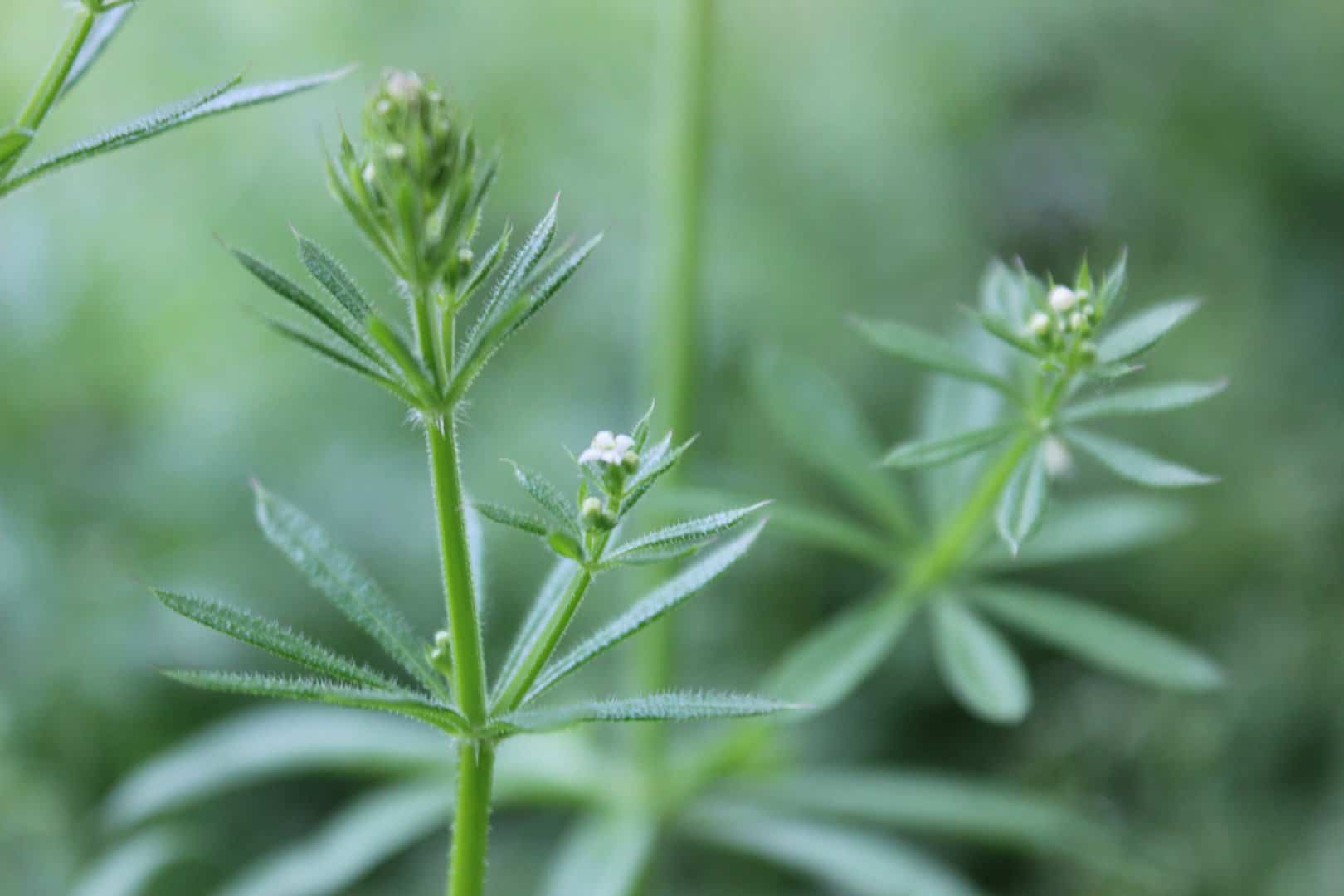
Cleavers is a humble, gentle plant, yet it’s very effective. It is a good illustration of the Water element, as it thrives in moist environments, and you can see that it’s full of fluid when you pinch it. Cleavers has a mineral salt taste. It affects the lymphatics and urinary tract as a diuretic, and it reflects the Pisces and Scorpio aspects of the Water element. Because Cleavers is diuretic, it will be drying over the long term. For short-term, acute use, it has a soothing, slightly moistening effect in the urinary tract. Cleavers is excellent for sharp, hot, scalding urine in a urinary tract infection. If someone has a lower UTI, especially with inguinal lymphadenopathy, it’s a perfect herb.
Marshmallow (Althaea officinalis)
This is a fantastic example of a Water element herb. Marshmallow is very soft and lush-looking, with creamy white flowers. The root also has a creamy white color, is very moist, and has a sweet taste. It is mucilaginous and full of polysaccharides that are only hydrated by water. You can’t extract this herb very well with alcohol. Technically, you can use a very low alcohol percentage, but water is best for extracting this plant. Marshmallow is one of our best demulcents. It is soothing, cooling, and moistening to the mucosal membranes of the GI, respiratory, and urinary tracts. This is a classic Cancer herb, and it clearly expresses the Water element and lunar quality. This is an excellent herb for constitutional dryness because it increases the body’s fluid element. From a Chinese perspective, Marshmallow builds yin. From an Ayurvedic perspective, it increases kapha. According to Medical astrology, it increases Water and builds the Moon within the system.
Red Clover (Trifolium pratense)
Red Clover has a slight mineral salt taste and is mildly sweet. It has an affinity for the lymphatics and is specific for swollen lymph nodes. This is an excellent herb for the mucosa, especially of the lungs. Marshmallow is a good example of a Pisces-type herb because of its strong affinity for the lymphatics. Interestingly, Pisces tends to have weak lungs. Pisces doesn’t rule the lungs, but it is in a square relationship with the sign of Gemini, which rules the lungs. Because of that square relationship, the lungs in Pisces tend to be weak.
Red Clover is commonly used to support cancer. I’m not saying it’s a cure for cancer, but this is a classic herb used in traditional Western herbalism for breast and lymphatic cancers as an alterative. Breasts and lymph are related to Pisces. Red Clover is highly nutritive, and pastured animals eat it. My wife and I have a homestead, and we’ve got a lot of animals: sheep, pigs, cows, and they love to eat Red Clover. It is a common herb in nutritive tonic teas, along with Nettle leaf, Alfalfa, and Oat Straw, for its mineral-rich properties.
White Pond Lily (Nymphaea odorata)
This is a lesser-known herb, but we stock it in our dispensary at Natura Sophia Spagyrics. White Pond Lily is interesting because it’s both demulcent and a bit astringent, and those two qualities are polar opposites. Of course, it’s a pond lily, so it literally grows in swamps, marshes, and bogs. To harvest it, you have to wear waders, and it’s quite the adventure. That’s a very Scorpio kind of environment — stagnant, fixed waters. This herb has a reliable influence on the female reproductive and lower urinary tracts, which are Scorpio areas of the body. This plant clears dampness and stagnation from the lower urinary tract in the female reproductive system. It also astringes, tightens, and tonifies laxity and leakiness in the tissues. It is commonly used for vaginal discharge because it cleanses, moisturizes, and tones the tissues. It’s also good for cloudy urine and incontinence due to its astringency.
Horsetail (Equisetum arvensis)
Horsetail grows along creek beds and in watery environments. It has a mineral salt and astringent taste. This is a reliable diuretic herb that is also very nutrient-rich. It builds bone, connective tissue, and teeth through its silica content. Horsetail is a very earthy plant as well, and has Saturnian qualities. I think of Horsetail as a Saturnian herb because it’s an astringent, mineral-rich herb that strengthens the dense attributes of the body. However, it’s also a diuretic, so it flushes the kidneys and urinary tract, and it has a regulating effect on solids and liquids. Because of those attributes and the locations where it grows, it has a strong Water-element aspect.

FAQ on the Water Element Signs in People and Plants
What does the Water element represent in herbalism?
In herbalism, the Water element governs nourishment, hydration, emotional sensitivity, cleansing, elimination, and regeneration. It corresponds to fluid in the body (including the mucosa, lymphatics, and reproductive tissues) and to our emotions. At the School of Evolutionary Herbalism, the Water element is understood through the lens of medical astrology, Ayurveda, and Galenic humoral medicine. Giving herbalists a unified framework for understanding both the plants and the people they serve.
Which zodiac signs belong to the Water element?
Cancer, Scorpio, and Pisces are the three Water signs. Cancer is Cardinal Water, associated with nourishment and receptivity. Scorpio is Fixed Water, associated with purification and elimination. And Pisces is Mutable Water, associated with the lymph system and spiritual connection. Together, they form the Water trine, which maps to a complete cycle of intake, cleansing, and circulation within the body.
What constitutional pattern is associated with the Water element?
In Western herbalism, the Water element corresponds to the phlegmatic constitution, while in Ayurveda, it corresponds primarily to kapha and aspects of pitta. In Alchemy, Paracelsus described Water-related pathology as “tartaric diseases,” conditions of congestion and accumulation in the channels of elimination.
What tissues are most connected to the Water element?
The Water element governs the mucosal membranes, lymphatic tissues, reproductive tissues, and bodily fluids. In medical astrology, these are distributed across three Water signs: Cancer (rules the womb and mucosa), Scorpio (rules the colon, bladder, and reproductive system), and Pisces (rules the lymph).
What tastes are commonly associated with Water-element herbs?
The two primary tastes of Water-element herbs are salty-mineral and sweet. The salty-mineral taste is found in herbs like Nettle, Cleavers, and Horsetail. It often indicates an affinity for the urinary tract and kidneys. The sweet taste is found in mucilaginous herbs like Marshmallow root. It often indicates an affinity for the mucosa.
What is a demulcent herb, and which ones are associated with the Water element?
At the School of Evolutionary Herbalism, our students dive deep into herbal actions. Herbal actions are specific, repeatable effects that a plant can have on the body. One signature herbal action of Water-element herbs is demulcent. Meaning it moistens, soothes, and hydrates dry or irritated tissues.
Why are lymphatics associated with Pisces in medical astrology?
In medical astrology, Pisces represents the body’s universal waters, including the lymphatic system and extracellular fluids. They circulate throughout the entire body, cleanse the blood, and are a major component of the immune system. Just as Pisces strives toward unity and dissolution of boundaries, the lymph dissolves and carries away waste from every tissue. Herbs with a strong Pisces affinity (Red Clover and Cleavers) tend to act directly on the lymphatic system.
Can Water-element herbs be drying?
Yes. Some Water element herbs regulate fluids by increasing elimination through actions such as diuresis or alterative cleansing. Diuretic herbs increase urination, producing a net drying effect over time. Alterative herbs open channels of elimination through the lymphatics, liver, skin, or bowel. The Water element governs both the intake of fluid and nourishment and the elimination of water and excess.
What are examples of Water element herbs?
Classic Water-element herbs include Cleavers (Galium aparine), Marshmallow (Althea officinalis), Red Clover (Trifolium pratense), White Pond Lily (Nymphaea odorata), and Horsetail (Equisetum arvense). Each herb example expresses a different facet of the Water trine (Cancer, Scorpio, or Pisces). Understanding that distinction helps herbalists choose the right plant for the right pattern.
How do Water element plants appear in nature?
Water-element plants commonly grow in moist environments and tend to be soft, lush, flexible, and fluid-rich. Their flowers are often white or pale, and the overall form of the plant tends to be flowing or cascading, rather than rigid. Willow is a classic visual example of a Water-element herb. These morphological signatures are a part of the doctrine of signatures, a traditional framework for reading a plant’s medicinal affinities through its physical appearance and habitat.