How I Met Herbal Practitioner Margi Flint
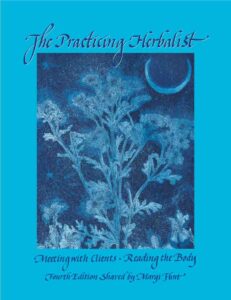
As I stood in front of my collection of herbal tomes recently, I knew it was Margi Flint’s book, The Practicing Herbalist, I wanted to tell you about. I met Margi long ago at an herb conference, and immediately knew we had a great connection. Back then, I was the new kid on the block when it came to teaching at herb conferences, and often I did not feel entirely welcome. Margi was one of the first herbalists of her generation to take me under her wing and encourage me, so she has a special place in my heart. Margi is a great herbalist and teacher, and I’m excited to tell you about her book, because if you want to be a practicing herbalist, you absolutely must have a copy. I had the honor of writing the foreword to the fourth edition.

About The Practicing Herbalist Book
Foundations: Starting An Herbal Practice & Seeing Clients
This book is unlike any other herb book out there. The foundation of the book is about starting a practice and thinking through how to define the kind of herbalist you are and the kind of practice you want. In this book, Margi goes into the logistics of working with people and the complexities that emerge when you begin. She takes you through the process of considering the people you want to serve and how to create a space that welcomes them. Whether you’re working with clients in person or remotely, you should have a space that looks professional and welcoming, and It’s important to make people feel comfortable.
Margi covers how to create an apothecary and dispensary. She then gives us some very practical guidance on working with people, such as booking appointments, working virtually, and marketing yourself. Those pieces form the foundation of the book — the practical aspects of being a practicing herbalist, and I haven’t seen this information in any other herb book before.
Next, Margi gets into the details of doing thorough intakes. This is an area where Margi is truly one of the best. She is masterful at the intake interview, at reading the body, and at assessing. Reading the body involves examining facial lines, tongue, pulse, nails, and hair — a comprehensive way of looking at a client’s pattern, and she covers this in this book.
I see Margi as a master of the doctrine of signatures in people. We usually think of the doctrine of signatures in terms of plants. When a plant looks like a heart, we see that it may be good for your heart. Perhaps a plant looks like the brain’s hemispheres, so it’s good for the brain.
Another valuable aspect of this book is that Margi discusses examining the lines on the face and the tongue, including its coloration and coating. Where is it thick or thin? Where is it peeling? What’s the color? Is it yellow, pale, or red, for example? Of course, she covers the pulse, where she talks about discerning whether it’s high or low, tense or relaxed, etc. Then you put all of those layers of testimony together along with your interview and your intake to understand what is going on, which is the ultimate goal of an intake procedure.
When I was a newer practitioner, I would have said, “What is the root cause of the problems this person is facing?” As I’ve gotten older and learned more, now I say, “What are the root causes (plural) of what’s going on for this person?” In my experience, the cause is rarely a taproot. More often, it is like a rhizomatous network of interconnected factors that leads people to their relative state of health or disease.
In this book, Margi provides incredible intake protocols. She even gives you a blank intake form to use. In chapter 7, “Asking Questions,” she explains how to conduct a case history and obtain dietary information, which can be really tough to get. She goes into an organ-system-by-organ-system evaluation, using specific questions to gather information from the person. If you don’t get the right information from the person during the intake, you won’t be able to find the right remedy. And if you’re not going to get the right remedy, you’re not going to have much success as an herbalist. And so she is one of the very best at breaking down this process and teaching you how to do great intakes.
Special Topics You May Encounter with Clients
The rest of the book provides in-depth information on a variety of therapeutic dynamics. There are multiple chapters on cancer, and I believe that Margi is herself a cancer survivor. There are several chapters on Lyme disease. For those of you living in the northeastern United States, this is an important topic. Lyme disease is spreading across the U.S., and it’s especially prevalent in the Northeast. David Winston is highly experienced in Lyme disease and is a major contributing author to the Lyme disease sections.
Margi covers autoimmune disease, viral infections, insulin resistance, chronic pain, disrupted sleep, headache, and head trauma. There’s a huge section on the endocrine cascade and endocrine glands. There is a lot of detail on some of the more common issues practitioners may encounter with their clients.
A Deep Dive Into the Client Health Assessment
My favorite parts of the book are the sections on energetics and assessment. The first part of the assessment section is about the client interview process. Margi has some incredible chapters on constitutional body types. She explains how to assess vāta, pitta, and kapha using Ayurvedic methods. She teaches you about the four humoral temperaments of Galenic medicine: sanguine, choleric, phlegmatic, and melancholic. She couples that with the six tissue states that Matthew Wood reinterpreted from the physiomedicalist understanding of tissue states, uniting them with some other models. I use that system too, and I find it very useful.
Margi goes into the fundamental energetic patterns that you need to learn to assess in people. After that, you get a deep dive into how to actually do that. There is a chapter on assessing the tone of the voice and what to listen for. She explains the sounds of vāta, pitta, and kapha voices. She talks about the meaning of colors in the body: When you’re examining a body, there are many colors. You’re looking at the skin, eyes, and sclerae. You’re looking at nail beds and the tongue. Perhaps you’re looking at expectorated material if someone’s coughing up phlegm. You’re potentially talking about the color and nature of someone’s urine or their feces. Color carries significant meaning in holistic assessment and evaluation, so she delves into their meanings.
Next is one of my favorite areas, the sections on organ and body correspondences. Margi goes through the body’s primary organs and discusses their relationship to the various diagnostic methods you can use. For example, if you’re assessing the small intestine, where might you look on the face? Where do you feel the small intestine in the pulse? Where do you look in the eyes or the fingernails? Where do you look on the tongue?
In the back of the book, there are some truly awesome cheat sheets. For example, on the lung cheat sheet, she tells you where to look on the tongue or in the pulse. She says that butt pimples indicate that the person is too sedentary (the lungs need movement). She provides a variety of features to look at in the nails and on the face, and identifies areas in the body that show tension or tightness. This section is really useful, because the cheat sheets show where you find the testimonies in the body for particular organ systems.
Next, Margi goes into the various examinations. Examining the face is one area of Margi’s work that I find really fascinating. In this section, she covers the body areas that correspond to the face. For example, the heart is in the nose; the whole jawline and chin are like the pelvic floor; the stomach is around the lips; and the small and large intestines are the lines on the forehead. Specific areas of the face correspond to specific organs of the body. What you’re looking for are lines in the face. You can also look at coloration, dryness or oiliness, things of that nature. Examining the ears, examining the eyes, and she goes into a lot of detail here: the eyebrows, the color of the sclera, the pupils, below the eyelid, these areas under the eyelid, looking at all these different aspects of the eyes, the nose, the teeth, the mouth, the lips, the chin.
Next, Margi goes into a tongue assessment, which is very cool. She uses the tongue chart by William LeSassier, one of her main teachers, which is much more specific than any other tongue diagram I’ve seen. For example, in the chart for tongue diagnosis related to the mouth and lips, she shows you what it means if only the lower lip is chapped. Or what it means if the client is holding their mouth open much of the time. Or if there’s a dark outline surrounding their lips. She tells you what it means if the corners are turned down or drooping.
Margi includes sections on assessing the hands, fingernails, feces, urine, the pulse, and so much more. This book is more than 500 pages, and it’s simply incredible, unlike any other herb book on my shelf, and I have a lot!
Is This Book for Herbal Practitioners Like Me?
This is not for beginners; I have to be honest about that. This is for people who really want to practice or are already practicing. If you are currently practicing, you should definitely have this book. It levels up every area of your work as an herbalist, from the assessment process to the logistics of running your practice.
Where to Get The Practicing Herbalist
You can purchase The Practicing Herbalist directly from Margi here. This is a pricey book, so if it feels out of your price range, put it on your gift list! Margi self-publishes this book, so when you purchase it, you are supporting her work. I encourage you to get the most recent edition, which, as of this writing in 2026, is the fourth edition.
If you ever have the chance to take a class with Margi, she teaches at a lot of conferences around the United States, and she’s a fantastic teacher and a lovely woman, and I can’t recommend her teaching or her book highly enough.
The Vitalist Herbal Practitioner Program
There’s a lot to learn to be an effective practicing herbalist, and The Vitalist Herbal Practitioner Program covers pretty much all of it. Enrollment is open now, and I would be honored to have you join us! But be sure to sign up now — enrollment ends this Friday.
FAQ About The Practicing Herbalist Book
Who is The Practicing Herbalist for?
This book is best suited for serious herbal students, clinical herbalists, and practitioners who want to improve their assessment skills and client care. This is not a book for the beginning herbalist. While motivated beginners may benefit from it, the book is especially valuable for those who plan to work with clients or who are already practicing herbalists.
What makes this book different from other herbal books?
Unlike most herbal references, this book focuses on the realities of practicing herbalism, including client intake, assessment methods, practice management, marketing, and business logistics.
Does The Practicing Herbalist teach herbal assessment and diagnostic skills?
Yes. A major focus of the book is learning how to assess clients through interviews, tongue observation, pulse assessment, facial analysis, body signs, constitutional types, and energetic patterns.
Does the book include intake forms and clinical tools?
Yes. Margi Flint provides detailed intake protocols, sample forms, assessment charts, and practical reference materials for use in clinical practice.
What health topics does Margi Flint cover in The Practicing Herbalist?
The book includes chapters on cancer support, Lyme disease, autoimmune conditions, insulin resistance, chronic pain, sleep issues, endocrine health, viral infections, and more.
Does the book cover Ayurvedic and energetic assessment methods?
Yes. It explores the Ayurvedic doshas (vāta, pitta, and kapha), Galenic temperaments, tissue states, constitutional assessment, and other energetic models used in holistic practice.
What is the biggest benefit of reading this book?
It helps herbalists develop stronger assessment skills, conduct more effective client intakes, and build a professional herbal practice with greater confidence and clinical effectiveness.